



The relationship between males and females, an intricate and ancient maze of battles, dominance, confrontation, investigation, debate. A topic that is complex and has never been resolved (and perhaps never will) and one that is frequently, in fact very frequently, approached from an “oppositional” perspective. This is precisely the dynamite on which they, the Eterobasiche, are sitting, and what do they do? They set it in irony, in videos that look as if they’ve been made just for laughs but instead allow them to talk about tough stuff, without taking themselves too seriously. In this way, a laugh, without a face-to-face confrontation, paves the way for a different way of engaging in dialogue. People drop their guard and, click, start talking to each other. Because life is hard for everyone, even without necessarily going to war.
We were very surprised that many, many men followed us and not because they felt offended, but because they wanted to understand,having had the opportunity to look at themselves from the outside
It is well known, as myths have told us for millennia, that a dose of good old cleverness can sometimes achieve more than grand displays of resistance. It may be their Roman origins, it may be the extraordinary gift they have of transforming potential offences into irony, Maria Chiara and Valeria are genuinely at one with the belief that the strength to speak a common language is more useful than winning battles of principle. Stripped of judgement, and dressed in irony, their project becomes a virtual square in which at the end everyone, for various reasons, takes a chair and begins to speak his or her mind. But they also find themselves listening to what others have to say. And since they are relaxed and not in the dock, instead of struggling to build a wall of defence, they may end up indulging themselves and questioning who they are and how they behave. This is how the Eterobasiche, with a smile and abundant wit, shine the spotlight on commonplaces that are older than Rome itself.
What’s Eterobasiche all about?
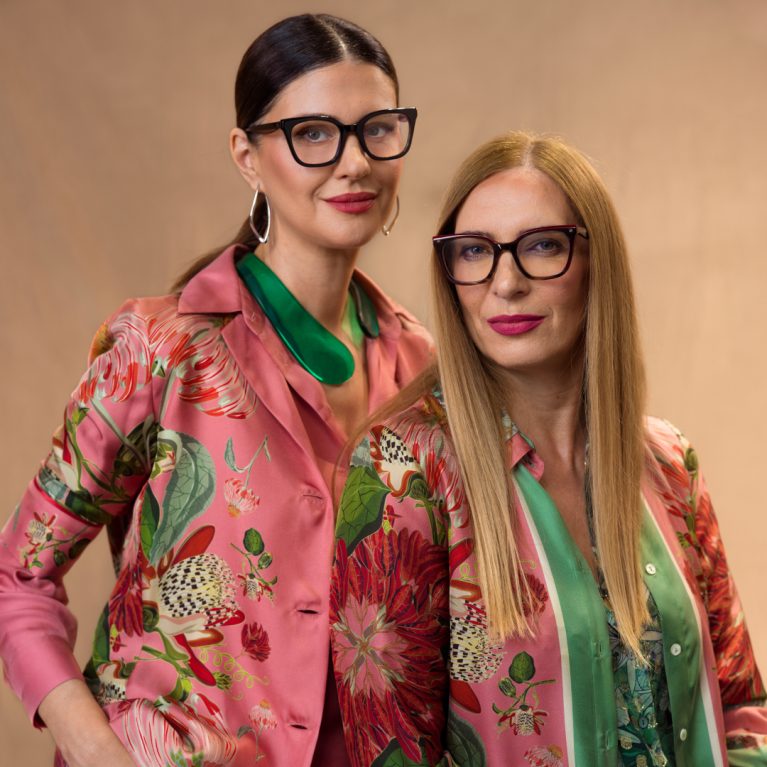
Eterobasiche is a project created on the web in November 2021 based on an idea by Maria Chiara Cicolani (25) and Valeria De Angelis (27). In their project, which today has more than 300,000 followers on social media, the two authors imitate straight basic males – that is, average Italian men – in common situations of daily life. They stage a kind of comedy that is performed with skill, that works and that, at the same time, provides important food for thought.
In their videos they talk about everything: music, sex, football, clichés, using a strictly Roman slang, male swagger and stereotypes. Winners of the Political Satire Award in the Social category in 2022, they have aired in prime time for 3 seasons in the “Belve” programme, presented by Francesca Fagnani, RAI2 and on 30 April, 2024 they debuted with their first book, “Romanzo di un maschio”, published by Einaudi.
You’ve been making fun of us for a lifetime, now we’re really going to get our own back. That’s all it was in the beginning. Then we realised we had something big on our hands and maybe we needed to seriously do something about it.
But what are these Eterobasiche like, if you get to know them beyond the character? We had a nice chat with them, and they kindly gave it to us straight.
A partnership among women that tackles complex issues by adopting the persona of the average man. A choice that is undoubtedly out of the box. But how did this idea come about?
By chance, by boredom. Can you tell? It was summer, and we hadn’t been lucky enough to go on holiday and do cool things. We were in a forgotten village, at the lake and so, as a joke among friends, we filmed ourselves saying the classic phrases the Italian male might say on holiday, to make fun of our male friends: ‘Look at this, here in Italy we have everything! Do you know how much they’d charge you for this lake abroad? We have everything we need right here.’ and so on. Obviously in Roman slang. We put it on social media months later, just for the sake of it. But it immediately went super viral and we realised that stereotyping the average male had all the potential to become a format. We looked at each other and thought “Ok, you’ve been making fun of us for a lifetime, now we’re really going to get our own back”. That’s all it was in the beginning. Then, overnight, people began to recognise us on the street and it was very strange for us. That’s when we realised, we had something big on our hands and maybe we needed to seriously do something with it.
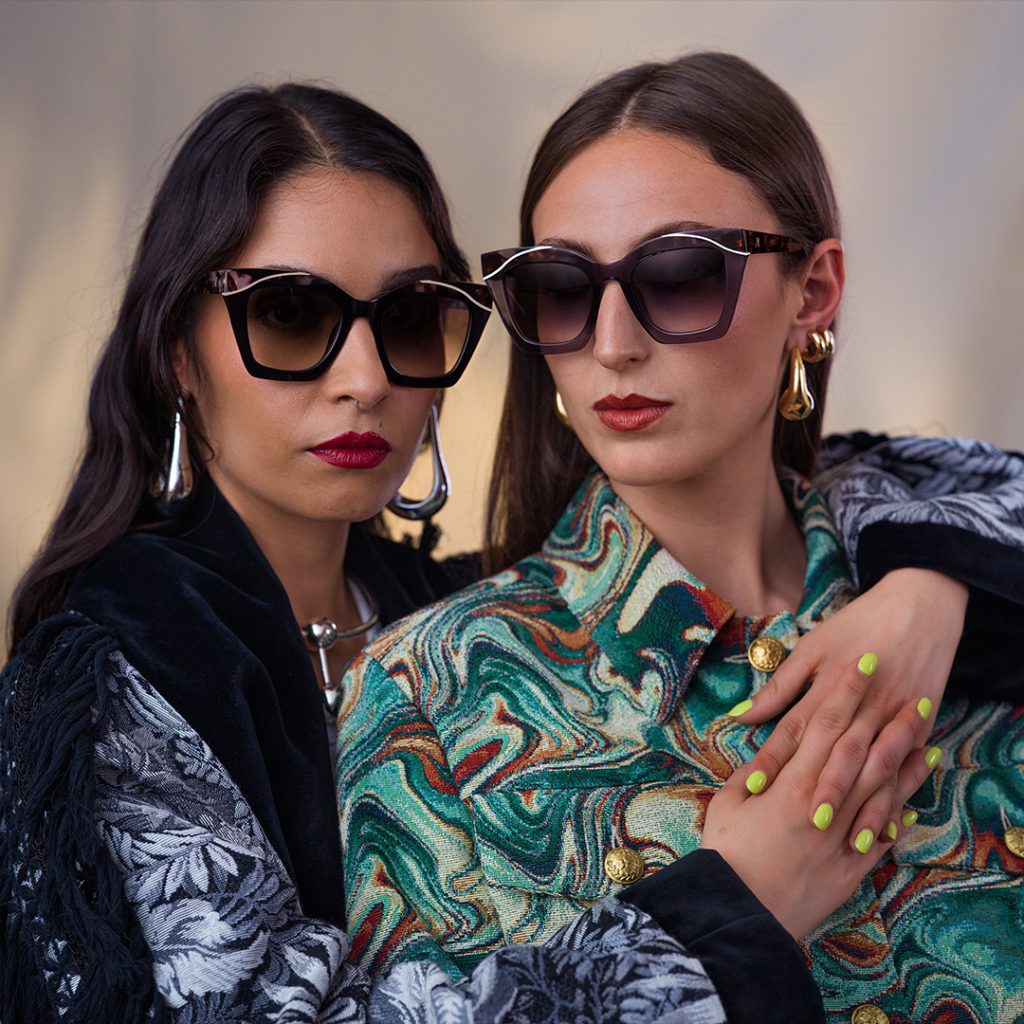
Let’s talk about #sisterhood: you are here now, rewriting the rules of the game, but actually you only met recently. Can we say that it was love at first sight? What was it that tied you together?
“Yes, we met practically three years ago and just a little while later the Eterobasiche project was born. Our partnership is not one of those that are based on a lifelong friendship. But when we met, we got on right away. Although we had lived different lives, we had always had very similar experiences. Always the tomboys of the group, when we met, we recognised this immediately: we share the same way of joking, even about the hardships of a life.
We are two very self-ironic people, and irony has allowed us to drag out and voice truths, some of which are uncomfortable, and which over the years have hurt, tired, disappointed us. We knew we certainly weren’t the only ones.”
Although we had lived different lives, we had always had very similar experiences. We are both very self-ironic, for us it was natural to joke even about what, for a lifetime, have been inconveniences.
There is a risk, in this society which is now more attentive to filters than to content, that the concept of female empowerment, of sisterhood, will be softened and lose its power. What’s your view on this?
“In fact, we sometimes encounter a narrative that describes a very glossy sisterhood, and that hides part of reality. Instead no, we must say how difficult it is to be sisters and how it’s not always a smooth road ahead, we don’t live in a world of sunshine and rainbows where everything comes naturally to us. Instead, we believe that we should be normalising saying that we also fight too sometimes, that at times we feel negative, but human feelings, such as envy, competition. It’s normal that this can happen and, those in such a situation should not feel in any way inferior to that image of sisters that we might sometimes see on social media, but that is not the whole reality. So undoubtedly yes, a tale of sisterhood that is too perfect can cause damage.
Because we are powerful, even with our fragilities. Because then maybe, in real life, you find yourself in situations of conflict and end up feeling like a stranger to the narrative. And therefore, not up to par, so you give up. But no, it’s completely normal; having a superpower is not being good and perfect, having a superpower is continuing to build together, despite everything. This is the heart of a #sisterhood. We are human beings, we are imperfect. Maybe one day you just woke up on the wrong side of the bed and you’re looking for an argument. And then, if you consider that we women also have to juggle the emotions that come with our period… it’s a mess.”
There is (also) a very glossy narrative of sisterhood, which hides part of reality. Instead no, it must be said how difficult it is to be sisters and how it is not a positive path, in which we live in the world of flowers and everything comes naturally to us.
Feminism is, to this day, a controversial topic. You have chosen to do your bit by riding the untamed beast of irony. What is the potential you see in this approach?
“Irony certainly has the ability to relax and soften those defensive attitudes that, too often, arise and prevent dialogue. The positions end up becoming polarised, as if there were a male world against a female world, the gap increases and the problem gets worse.
On the other hand, irony, you know, is a means that seems trivial, so you watch a video, just to have a laugh, it’s something silly. But this thing, in the end, allows people not to take themselves too seriously and maybe start a dialogue, starting with a laugh.
Let’s say that, character-wise, our path was somewhat set in this regard. Take away our self-irony, and you take away our air. Plus, we’ve never been afraid of swearing, and we really like going to watch football. Irony has allowed us to create a meeting point and show men that women are not always perfectly groomed, precise, composed.
Laughter creates a point of contact and this is an urgency on everyone’s lips these days. The kind of feminism that does not question how to create a dynamic dialogue between the parties is obsolete (in our opinion).
It was a lovely surprise for us, to see that many, many men were following us. And not because they felt offended, but because they wanted to understand. For the first time, however, they had the opportunity to look at themselves from the outside and laugh with us about something that everyone still harbours. Not only men, but women too, because it is often a sexism rooted in our own community and, in our videos, we want to somehow shine the spotlight on this. Ironically, even the basic straight male can lower his defences and say ‘OK, let’s make contact, laugh for a moment together and understand where these stereotypes come from’.”
Irony, you know, may seem like a trivial tool, but it allows people not to take themselves too seriously and maybe establish a dialogue, starting with a laugh.
In short, boys versus girls does no-one any good. Imperfect, but less polarising approaches are better. In the end, what really matters is not the purity of the form (and here the irony would be wasted) but being able to take a new step, towards common ground.
In closing, beyond your sense of personal achievement and success, what is the most intimate, noblest hope you place in the @Eterobasiche project?
“We have very often been stopped by men asking us ‘But how I’m I supposed to take this thing (the videos)?’ Well, for us, even this alone is a great success, because we often find ourselves in the middle of debates on feminism, with trained interlocutors, discussing the subject with flawless pertinence. But the difficult job is to get to those who are on a really different wavelength, but who sooner or later have to be involved. We’ve taken on a complicated role; we’re well aware that the way we joke can be misunderstood, and that some might confuse the different levels of reality. But the goal is to begin building a bridge with those who may not have yet found themselves in the situation of stopping to reflect. In today’s world, however, even for men it is not easy to understand, in the name of deconstruction, which new construction of identity to embrace. So the desire is that this project becomes, to some extent, a useful tool for beginning to rethink, together, a new male identity within feminism. This is something we all need to work on. With our project we hope we are taking a step forward. Our ideal would be to try to dialogue more and more.”
The difficult job is to get to those who are on a really different wavelength, but who sooner or later have to be involved. The goal is to start building a bridge.